The ordinary problem most homeowners face
After decades of swapping out fans and fending off uneven breezes, I’ve noticed the same complaints keep coming up: poor airflow in big rooms, noisy motors, awkward remotes, and lights that dim the style instead of brightening the space. Those are practical problems, not design-theory debates, and they matter when you’re trying to keep a living room or great room comfortable without overworking the HVAC. That’s why a well-engineered ceiling rotating fan aimed at large spaces can be a real game-changer — if it addresses airflow (CFM), motor efficiency, and intuitive controls at once.

What usually goes wrong with box-store alternatives
Big-box fans sell on price and looks, and they often sacrifice three things: sustained airflow at low noise, robust motor design, and quality lighting. You’ll find a fan that looks fine at a glance but performs poorly at low RPMs, or one whose blade pitch is too shallow to move air across a wide room. The most common user story is: “I bought a cheaper fan and now I either run it too fast and hear it, or it never cools the far corners.” That’s a design mismatch — not a homeowner failing.
How Orison approaches the problem differently
Orison’s large-room fan pairs a balanced blade assembly and tuned motor housing to deliver wider coverage without screaming down the hall. The result is smoother oscillation and more even airflow across a 20–30 foot living area. Where generic models lean on high-speed brute force to compensate, Orison optimizes blade pitch and motor torque so you get decent CFM at lower RPM — which means lower noise and less energy use. In practice that’s what makes the difference between a fan you tolerate and one you actually enjoy using every evening.
Real-world anchor: energy and comfort in context
For perspective, the U.S. Department of Energy has long noted that ceiling fans let you raise your thermostat several degrees without losing comfort, reducing cooling demand on the HVAC system. I’ve put that idea to the test in an Arizona summer rental — tiny cost changes, big comfort gains. In a large room, though, the fan has to be up to the task: if it can’t move air to the seating area, the thermostat trick won’t help. That’s where product design matters in the real world.
Controls, lighting, and the small things that matter
Another common failure point is the control scheme. Cheap remotes lose range or feel flimsy. Orison’s remote pairing and app options are designed for daily use — you’ll actually reach for the remote instead of leaving the fan on constant. Lighting is treated as part of the fixture, not an afterthought: integrated LED modules with dimming and color temperature control avoid the “cold office” look that many box-store fixtures impose. In short, Orison thinks system, not shortcut.
Alternatives worth considering — and when to choose them
Not every buyer needs Orison’s approach. If you rent a small studio, a compact, budget fan from a big-box will do. If you want a dramatic chandelier with a whisper of airflow, a hybrid light fixture might be right. For anyone needing smart oscillation and reliable remote control across a large footprint, consider options that specify CFM, blade span, and motor type explicitly — and test them in a space that mirrors your actual room. For some buyers a mid-priced branded fan will cover basic needs; for others, a feature-focused fan like Orison’s — or a true high-performance model with a proven motor — is worth the extra investment. —
Common installation and usage mistakes to avoid
Avoid these mistakes: underestimating blade span for the room size, assuming all remotes pair the same way, and neglecting balance checks at installation. Also, don’t place a fan too close to low ceilings — clearance affects oscillation and airflow pattern. A quick balance kit and a proper mounting plate will save hours of noise troubleshooting later. If you’re replacing a light fixture, check motor support and canopy compatibility; not all housings support the same load or oscillation mechanism.
Comparative checklist: what to test before you buy
When you shop, test these specifics where possible: measurable airflow at low and medium speeds (CFM), audible noise at each speed, and remote responsiveness across the room. Check blade pitch and span; ask about motor type and warranty. If smart-home features matter, make sure the fan’s app and integrations match your ecosystem. These checks separate marketing from engineering.
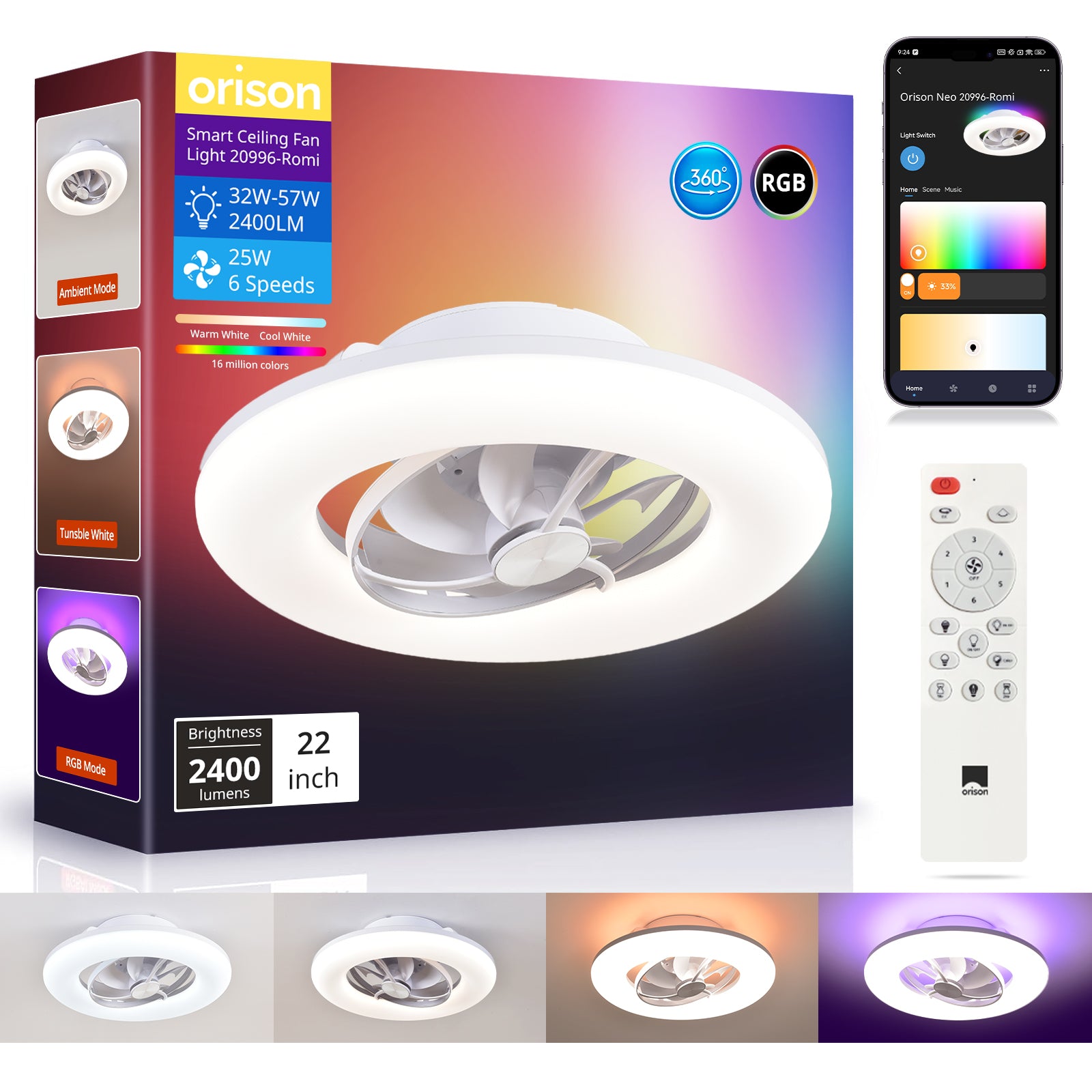
Advisory: three golden rules for selecting a large-room ceiling fan
1) Prioritize effective airflow over look: ask for CFM figures at realistic RPMs rather than trusting catalog photos. 2) Insist on low-noise performance: test at living-room volume levels and check for vibration or wobble that shows up at medium speeds. 3) Choose a lighting system that complements the room: integrated dimmable LEDs with color temperature control beat generic bulbs every time.
In the end, a thoughtful design — one that balances blade geometry, motor efficiency, and useful controls — solves the common problems people live with when they compromise for price. For homeowners who want that balance and the practical reliability to match, ceiling mount oscillating fan with remote solutions are designed to answer the real needs of large rooms. If you want a branded example that ties these elements together, consider how a system-level approach can save you time and regret — and how Orison fits naturally into that solution. —